1. Introduction
As consumer interest in health-promoting foods has increased and eating habits have shifted toward convenient yet nutrient-dense options, muesli has gained popularity as a quick and functional breakfast choice
| [1] | Amanat, T., Tariq, M. U., Sami, H. A., Shujah, H., Tahir, S., Shabbir, H., Kasperkiewicz, K., Gaafar, A.-R. Z., & Elshikh, M. S. (2023). Exploring the therapeutic potential and bio-evaluation of Muesli (Chlorophytum Borivilianum) for the management of postprandial glucose management in healthy and diabetic female subjects. Pakistan Journal of Pharmaceutical Sciences.
https://doi.org/10.36721/PJPS.2023.36.2.SP.639-642.1 |
[1]
. Oat flakes and nuts are main ingredients in many functional muesli formulations due to their nutritional benefits: oats contribute to gut health and immune support through their soluble fiber and bioactive compounds
| [2] | Alemayehu, G. F., Forsido, S. F., & Amare, E. (2023). Nutritional and phytochemical composition and associated health benefits of oat (Avena sativa) grains and oat‐based fermented food products. The Scientific World Journal.
https://doi.org/10.1155/2023/2730175 |
[2]
, while Brazil nuts provide an exceptionally rich source of selenium, up to 1920 μg 100 g⁻
1, which plays a vital role in immune regulation, antioxidant defense, and the prevention of age-related diseases
| [3] | Silva, A. da, Silveira, B. K. S., de Freitas, B. V. M., Hermsdorff, H. H. M., & Bressan, J. (2022). Effects of regular Brazil nut (bertholletia excelsa H. B. K.) consumption on health: A systematic review of Clinical Trials. Foods 11(18).
https://doi.org/10.3390/foods11182925 |
[3]
.
Oats are naturally gluten-free and provide valuable dietary fiber, β-glucans, and bioactive compounds, making them an important ingredient in many functional cereal products
| [2] | Alemayehu, G. F., Forsido, S. F., & Amare, E. (2023). Nutritional and phytochemical composition and associated health benefits of oat (Avena sativa) grains and oat‐based fermented food products. The Scientific World Journal.
https://doi.org/10.1155/2023/2730175 |
[2]
. Celiac disease, a chronic autoimmune disorder triggered by gluten ingestion, leads to villous atrophy, impaired nutrient absorption, and a higher prevalence of micronutrient deficiencies. Among these, selenium deficiency is particularly common due to both malabsorption and the restrictive nature of the gluten-free diet
. To address this nutritional vulnerability, the present research incorporates gluten-free oat flakes paired with Brazil nuts, the richest known dietary source of selenium, as an approach to enhance selenium intake in formulations designed for both the general consumer population and individuals with celiac disease.
Toasting generates flavor and aroma compounds, modifying texture, and influencing color development. For oats, toasting can enhance desirable Maillard reaction products that improve aroma and crispness; however, excessive heating or prolonged exposure may cause over-browning, off-flavors, or textural degradation
| [5] | Li, X., McGorrin, R. J., & Heydanek, T. (2022). Effect of industrial processing on the volatiles, enzymes and lipids of wholegrain and rolled oats. Food Research International 157. https://doi.org/10.1016/j.foodres.2022.111243 |
[5]
. The Maillard reaction is an important non-enzymatic browning process that significantly contributes to flavor development and can produce both beneficial and potentially detrimental compounds depending on the conditions applied
| [6] | Törős, G., Peles, F., Elramady, H. & Prokisch, J. (2023). To what extent can maillard reaction products influence the probiotic and harmful bacteria?. Egyptian Journal of Soil Science.
https://doi.org/10.21608/ejss.2023.189687.1569 |
[6]
. For Brazil nuts, which contain high levels of unsaturated fatty acids, heat treatment requires careful control, as toasting can accelerate lipid oxidation, promote oil release, and diminish sensory quality if temperatures are too high. In addition, thermal processing influences the levels and bioaccessibility of health-promoting constituents such as phytochemicals, vitamins, minerals, and fatty acids
| [7] | Apaydın, H., Demirci, M., Bölük, E., Kopuk, B., & Palabiyik, I. (2024). Effect of different roasting conditions on the physicochemical properties, acrylamide concentration, and mineral bioaccessibility of nuts. Food Bioscience 58.
https://doi.org/10.1016/j.fbio.2024.103646 |
[7]
.
Beyond nutritional value, sensory quality, including flavor, aroma, texture, and appearance, plays a crucial role in consumer acceptance. Therefore, optimizing processing conditions to achieve favorable sensory characteristics is fundamental to the successful development of functional food products. Research highlighted that specific sensory attributes, such as crispness, nutty flavor, and balanced sweetness, strongly influence consumer preference for oat flakes. Their preference mapping demonstrated that consumers are particularly sensitive to both texture and flavor, with crisp, well-textured flakes and appealing nutty notes being most favored
. These findings underscore the importance of controlling processing parameters, such as toasting, which can significantly affect the development of aroma, flavor, and texture in both oat flakes and nuts.
Moisture content is another key quality parameter, strongly affecting both texture and microbiological stability. Excess moisture leads to softness, clumping, and increased spoilage risk, while overly dry products may become excessively hard or brittle
. Oat flakes are typically dried to a moisture range of about 4-12%, and maintaining moisture below approximately 9.3% (dry basis) is recommended to preserve their structural integrity
| [10] | Gates, F., Dobraszczyk, B., & Salovaara, H. (2022). The effect of processing on the mechanical properties of Oat Flakes. ASABE Technical Information Library.
https://doi.org/10.13031/2013.9681 |
[10]
. For Brazil nuts, safe storage is generally achieved at moisture contents between 3-8%, with fungal growth risks increasing above ~8.2% (dry basis)
. In a functional muesli formulation, achieving the right moisture balance is essential not only for texture and stability but also for the protection of sensitive nutrients such as selenium.
Nuts are an important component of a healthy diet, as they provide substantial amounts of protein, carbohydrates, dietary fiber, vitamins, minerals, and unsaturated fatty acids. However, their high content of unsaturated fats makes them particularly susceptible to oxidative deterioration when exposed to factors such as oxygen, light, heat, moisture, and postharvest processing. Lipid oxidation in nuts accelerates the development of rancid off-flavours, reduces nutritional quality, and shortens product shelf life. Oxidative rancidity in nut oils is commonly assessed by measuring peroxide value, which reflects the formation of primary oxidation products
| [13] | Tahmasbian, I., Wallace, H., Gama, T. & Bai, SH. (2021). An automated non-destructive prediction of peroxide value and free fatty acid level in mixed nut samples. LWT 143.
https://doi.org/10.1016/j.lwt.2021.110893 |
[13]
.
Thermal processing, such as roasting or toasting, is widely used in cereal and nut processing and can significantly influence the total phenolic content (TPC) and antioxidant capacity of plant-based foods. In oats, heat treatment has been reported to modify phenolic composition by increasing extractability of bound phenolic compounds through the disruption of cell wall structures. For example, toasting of oat flour has been shown to increase TPC by up to 27%, indicating enhanced availability of antioxidant compounds following moderate thermal processing
| [14] | Sandhu, K. S., Godara, P., Kaur, M., & Punia, S. (2015). Effect of toasting on physical, functional and antioxidant properties of oat flour (Avena sativa L.) cultivars. Journal of the Saudi Society of Agricultural Sciences, 16(2), 197-203.
https://doi.org/10.1016/j.jssas.2015.06.004 |
[14]
. Similarly, roasting of nuts has been associated with changes in phenolic content and antioxidant activity, although the direction and magnitude of these changes depend strongly on processing conditions. Studies on various nuts have demonstrated that moderate roasting can increase TPC and antioxidant capacity, likely due to improved extractability of phenolic compounds and the formation of Maillard reaction products with antioxidant properties
| [15] | Chandrasekara, A. & Shahidi, F. (2011). Effects of processing on antioxidant activity of cashew nuts. Journal of Agricultural and Food Chemistry, 59(8), 4372-4381.
https://doi.org/10.1021/jf2000772 |
[15]
. However, excessive heat exposure may also lead to degradation of thermolabile phenolics, resulting in reduced antioxidant potential
| [16] | Lemos, M., Siqueira, E., Arruda, S., Zambiazi, R. (2012). The effect of roasting on the phenolic compounds and antioxidant potential of baru nuts [Dipteryx alata Vog.] Food Research International, Volume 48, Issue 2, 592-597.
https://doi.org/10.1016/j.foodres.2012.05.027 |
[16]
.
Therefore, this study aims to determine how variations in toasting temperature and time influence the sensory attributes, moisture content, peroxide value, total phenols and antioxidant capacity of oat flakes and Brazil nuts, with the goal of obtaining high-quality ingredients for muesli production while delivering optimal sensory acceptance and product stability.
2. Materials and Methods
2.1. Sample Preparation
Gluten-free oat flakes originated from Poland were used as the raw material for all experiments. To investigate the impact of toasting on sensory quality and moisture content, oat flakes were toasted in an oven (Memmert, UN55, Germany, Schutzari) at three different temperatures: 120 °C, 150 °C, and 180 °C. For each temperature, four toasting durations were applied: 5, 10, 15, and 20 minutes, resulting in a total of 12 oat flake samples. For every treatment, about 22 g of oat flakes were arranged in a single layer on a metal tray before being transferred to a preheated oven. After toasting, samples were allowed to cool at room temperature before analysis. Between different tests, all products were vacuum packed and stored at room temperature. The study was conducted at the Latvia University of Life Sciences and Technologies in 2025.
Brazil nuts originated from Brazil were toasted in an oven (Memmert, UF55, Germany, Schutzari) at four different temperatures: 120 °C, 130 °C, 140 °C, and 150 °C, each with four toasting durations: 5, 10, 15, and 20 minutes, resulting in a total of 16 nut samples. For each treatment, approximately 25 g of Brazil nuts were evenly spread in a single layer on a metal tray and placed in a preheated oven. After toasting, nuts were cooled to room temperature before moisture, peroxide value, and sensory analysis. It should be noted that due to variations in nut size, the reduction in moisture content was not entirely uniform across samples. Between different tests, all products were vacuum packed and stored at room temperature.
2.2. Sensory Evaluation
The sensory evaluation was performed by a panel of two assessors, including one trained and one untrained panelist, to provide both expert and consumer perspectives. The evaluation was conducted under controlled laboratory conditions at room temperature. Samples were presented without coding and assessed sequentially. Panelists used tea as a neutralizing agent to cleanse the palate between tasting samples. A descriptive sensory evaluation chart was developed based on ISO 13299: 2016 methodology
to guide the assessment of toasted oat flakes and Brazil nuts (
Table 1). The chart provided standardized criteria for evaluating key sensory attributes, including appearance, consistency, aroma, and taste/aftertaste. Each attribute was associated with specific descriptors and assigned a quality score from 1 to 3, where 3 indicated “very good,” 2 indicated “average,” and 1 indicated “unsatisfactory.” The total score for each sample was calculated and interpreted as follows: scores of 11-12 represented very good quality, 9-10 good quality, 7-8 corresponded to average quality, while scores of 6 or below were classified as inadequate quality. This structured scoring approach is widely used in sensory analysis and allows quantitative comparison of product quality across treatments
. As the study involved food product evaluation without human health intervention, formal ethics committee approval was not required.
Table 1. Descriptive Sensory Evaluation Chart of Toasted Oat Flakes.
Properties of oat flakes | Characteristics | Quality number | Oat flake quality |
Appearance | Even, non-sticky, unbroken flakes, light golden, even tone | 3 | Very good |
Some flakes broken, crumbled, light cream-colored, slightly dull | 2 | Average |
Unattractive appearance, dark brown, slightly burnt surface | 1 | Unsatisfactory |
Consistency | Flakes evenly swollen, firm | 3 | Very good |
Flakes are unevenly expanded | 2 | Average |
Flakes too hard or soft | 1 | Unsatisfactory |
Aroma | Very strong, characteristic oat aroma | 3 | Very good |
Faint oat aroma | 2 | Average |
Uncharacteristic, burnt aroma | 1 | Unsatisfactory |
Taste, aftertaste | Pleasant oat taste | 3 | Very good |
Faint, sweet, burnt aftertaste | 2 | Average |
Bitter taste and aftertaste | 1 | Unsatisfactory |
External appearance was assessed for dry samples by weighing 10 g of each oat flake sample into a container and visually examining color, shape, and uniformity. To evaluate consistency, aroma, and taste, approximately 20 mL of cold milk was poured over 10 g of each sample, stirred, and assessed after 5 minutes. A total of 12 oat flake samples, toasted at different temperatures and times, were evaluated to compare their sensory characteristics.
A descriptive sensory evaluation chart was developed to guide the assessment of toasted Brazil nuts (
Table 2). The chart provided standardized criteria for evaluating key sensory attributes, including appearance, consistency, aroma, and taste/aftertaste. Each attribute was assigned a quality score from 1 to 3, where 3 indicated “very good,” 2 indicated “average,” and 1 indicated “unsatisfactory.” The external appearance was assessed by weighing 10 g of nuts into a container before evaluation. The same scoring classification was applied to the evaluation of Brazil nuts.
Table 2. Descriptive Sensory Evaluation Chart of Toasted Brazil Nuts.
Properties of nuts | Characteristics | Quality number | Nut quality |
Appearance | Evenly toasted with a golden brown color | 3 | Very good |
Nuts are slightly unevenly toasted, there may be darker or lighter pieces in some places | 2 | Average |
Nuts are too dark | 1 | Unsatisfactory |
Consistency | Nuts are evenly toasted, with a pleasant, hard and crunchy texture. Nuts are drier, but not too brittle, with a stable structure | 3 | Very good |
Nuts are slightly unevenly toasted, and may be a bit softer or more brittle in some places. Nuts are a bit more moist or slightly sticky, but overall still enjoyable | 2 | Average |
Texture is soft, wet, or sticky, indicating damage or overheating | 1 | Unsatisfactory |
Aroma | Nuts emit a pleasant, rich and fresh aroma with a distinct nutty scent | 3 | Very good |
Nuts have a pleasant, but slightly less pronounced or slightly weaker aroma | 2 | Average |
Nuts emit an unpleasant, sour, burning aroma, which indicates spoilage or oxidation of the nuts | 1 | Unsatisfactory |
Taste, aftertaste | Nuts are pleasantly toasted with a rich, harmonious flavor. There are no unwanted or bitter aftertaste | 3 | Very good |
Nuts have a pleasant, but slightly less pronounced taste. There may be a slight bitterness, a burnt aftertaste | 2 | Average |
Nuts have an unpleasant, bitter or sour taste, indicating spoilage or a spoiled product | 1 | Unsatisfactory |
2.3. Moisture Content
Moisture content was measured in oat flakes and Brazil nuts using the oven-drying procedure specified in ISO 712-1: 2024
. For each analysis, about 2.0 g of sample was transferred into previously weighed containers. Oat flake samples were dried at 130 ± 2°C for 3 h, whereas Brazil nut samples were dried at 103 ± 2°C for 6 h. After drying, the samples were used to determine moisture content based on the loss in mass. Standard deviation was calculated for all measurements. For both ingredients, the average values of three replicates were calculated to ensure repeatability. The procedure involved weighing the empty container, then the container with the sample before drying, followed by weighing the container with the dried sample after baking. Moisture content (%) was calculated from the weight loss using the formula specified in ISO 712-1: 2024. The calculation takes into account the weights of both the container and the sample before and after drying
.
2.4. Determination of Peroxide Value
Brazil nuts from each sample (1.91-3.11 g) were crushed using a mortar and pestle. The crushed material was mixed with hexane and stirred for 20 min. The resulting mixture was centrifuged at 2300 rpm for 2 min using a HERMLE Z 287 A centrifuge. The method was used with a slight modification in which hexane replaced pentane. Hexane was removed from the extracted oil by heating at 70°C. The resulting oil was transferred to a conical flask
| [20] | Bai, S, H., Darby, I., Nevenimo, T., & Hannet, G. (2017). Effects of roasting on kernel peroxide value, free fatty acid, fatty acid composition and crude protein content. PLOS One 12(9).
https://doi.org/10.1371/journal.pone.0184279 |
[20]
.
The peroxide value (PV) of the oil samples was measured by iodometric titration following AOAC Official Method 965.33. Approximately 0.8 g of oil was accurately weighed into a 50 mL conical flask. To dissolve the sample, 5 mL of an acetic acid-chloroform (CH3COOH/CHCl3) solution was added, and the flask was gently swirled. Next, 0.1 mL of saturated potassium iodide solution was introduced, and the mixture was shaken for 1 min to allow the reaction to occur. Afterward, 6 mL of deionised water was added, and the released iodine was titrated with 0.01 M sodium thiosulfate (Na2S2O3) until the endpoint was reached. The peroxide value was expressed as milliequivalents of active oxygen per kilogram of oil (meq O2 kg⁻1 oil) and calculated using the following equation:
(S-B)(N)(1000)/mass of sample, g
Where:
B = volume of titrant, mL of blank.
S = volume of titrant, mL of sample.
N = normality of sodium thiosulfate solution.
2.5. Chemical Analysis
2.5.1. Extraction of Phenolic Compounds
Approximately 5 g of oat sample was ground for 10 s, and 4 g of the ground material was transferred into a beaker and mixed with 20 mL of solvent (acetone: ethanol: water, 7: 7: 6). After preparation, the samples underwent ultrasonic treatment in a WITEG WUC-D06H ultrasonic bath at 27°C for 10 min. The extracts were subsequently centrifuged at 3000 rpm for 10 min in a HERMLE Z 287 A centrifuge. The clear supernatant was carefully transferred to a 25 mL volumetric flask. The remaining residue was extracted a second time with 20 mL of the same solvent following the same procedure. The second extract was then combined with the first in a 50 mL volumetric flask, and the final volume was adjusted with the extraction solvent. The procedure was based on literature data
with some modifications. For Brazil nuts, fat was first removed: samples (~4.0 g) were crushed using a mortar and pestle, mixed with hexane, stirred for 20 min, and centrifuged at 2300 rpm for 2 min. After removal of hexane, 20 mL of extraction solvent was added, and the same extraction procedure as for oats was applied.
2.5.2. Determination of Total Phenolic Content
Total phenolic content (TPC) was analysed by the Folin-Ciocalteu colorimetric method using a modified version of the standardized ISO 14502-1 (93) procedure. For the analysis, 0.5 mL of the sample extract was combined with 2.5 mL of Folin-Ciocalteu reagent that had been diluted 1: 10 with distilled water. Next, 2 mL of sodium carbonate solution (Na2CO3, 75 g L⁻1) was added, and the reaction mixture was mixed thoroughly. A reagent blank containing all reagents except the sample extract was prepared alongside the samples. The reaction mixtures were incubated for 30 min at room temperature in the absence of light. After incubation, absorbance was recorded at 765 nm using a UV-Vis spectrophotometer (Shimadzu UV-1800, Shimadzu Corporation, Japan). Total phenolic content was quantified from a calibration curve constructed with gallic acid standard solutions and expressed as gallic acid equivalents (GAE). All samples were analysed in triplicate, and the average of three independent determinations was used for the final calculations. The results were reported as milligrams of gallic acid equivalents per gram of sample dry weight (mg GAE g⁻1 DW), taking into consideration the sample weight and the extraction volume used during sample preparation.
2.5.3. Determination of DPPH ̇ Radical Scavenging Activity
The antioxidant activity of oat and Brazil nut extracts was evaluated using the 2, 2-diphenyl-1-picrylhydrazyl (DPPH) radical scavenging assay following the method described previously
| [22] | Kruma, Z., Tomsone, L., Galoburda, R., Straumite, E., Kronberga, A., & Åssveen, M. (2016). Total phenols and antioxidant capacity of hull-less barley and hull-less oats. Agronomy Research, 14(S2), 1361-1371.
https://agronomy.emu.ee/wp-content/uploads/2016/05/Vol14_S2_Kruma.pdf |
[22]
. For the analysis, 0.5 mL of the sample extract was mixed with 3.5 mL of a freshly prepared methanolic DPPH solution (0.004 g DPPH dissolved in 100 mL methanol). The reaction mixture was incubated in the dark at room temperature for 30 min before measuring the absorbance at 517 nm. Antioxidant capacity was quantified using a calibration curve prepared from Trolox standard solutions (1-11 μM) and expressed as millimoles of Trolox equivalents per gram of sample dry weight (mmol TE g⁻
1 DW).
2.5.4. Determination of ABTS ̇+ Radical Scavenging Activity
The antioxidant activity of the extracts was further assessed using the ABTS radical cation decolourisation assay as described by Kruma et al.
| [22] | Kruma, Z., Tomsone, L., Galoburda, R., Straumite, E., Kronberga, A., & Åssveen, M. (2016). Total phenols and antioxidant capacity of hull-less barley and hull-less oats. Agronomy Research, 14(S2), 1361-1371.
https://agronomy.emu.ee/wp-content/uploads/2016/05/Vol14_S2_Kruma.pdf |
[22]
. Phosphate-buffered saline (PBS) was prepared by dissolving 8.18 g NaCl, 0.27 g KH
2PO
4, 1.42 g Na
2HPO
4, and 0.15 g KCl in 1 L of ultra-pure water. An ABTS stock solution (2 mM) was prepared in 50 mL of the PBS buffer, while a 70 mM potassium persulfate (K
2S
2O
8) solution was prepared separately using ultra-pure water. The ABTS radical cation was produced by combining 50 mL of the ABTS stock solution with 0.2 mL of the potassium persulfate solution and allowing the mixture to stand in the dark at room temperature for 15-16 h. Before analysis, the ABTS working solution was diluted with PBS until an absorbance of 0.800 ± 0.030 at 734 nm was obtained.
For the assay, 5 mL of the ABTS working solution was mixed with 0.05 mL of the sample extract. The reaction mixture was incubated in the dark at room temperature for 10 min, after which the absorbance was recorded. Phosphate-buffered saline (PBS) served as the blank. Antioxidant capacity was quantified using a calibration curve prepared with Trolox standard solutions (1-11 μM) and expressed as millimoles of Trolox equivalents per gram of sample dry weight (mmol TE g⁻1 DW).
2.6. Statistical Analysis
Moisture content and TPC determinations were performed in triplicate to ensure repeatability and reliability, and the data were reported as mean values ± standard deviation (SD). Sensory scores and peroxide values were summarized using descriptive statistics to describe variability across different toasting temperatures and durations. The effects of toasting temperature and duration on moisture content were analysed using one-way or two-way analysis of variance (ANOVA), depending on the experimental design. When statistically significant differences were observed, Tukey's honestly significant difference (HSD) test was performed for pairwise comparisons among the treatment means. Fresh, untoasted oat flakes and Brazil nuts were included as a control in the statistical comparisons. Differences were considered statistically significant at p < 0.05. All statistical analyses, including the calculation of means, standard deviations, analysis of variance (ANOVA), and post-hoc comparisons, were performed using the RStudio integrated development environment (IDE). Graphical visualization and preparation of tables for reporting the experimental results were performed using Microsoft Excel.
3. Results
3.1. Sensory Characteristics
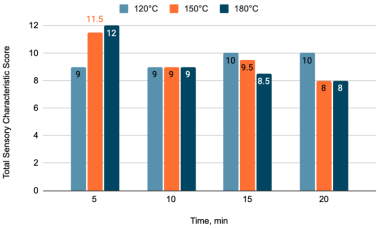
Sensory scores of oat flakes were analyzed to evaluate the effect of toasting temperature at each time point (
Figure 1). Scores for 12 samples, covering three temperatures (120, 150, 180 °C) and four durations (5, 10, 15, 20 min), were recorded. A one-way ANOVA was run at each processing time to test whether temperature affected the oat flakes’ overall sensory total score. At 5 minutes, temperature had a clear impact (F (2, 3)=31.0, p < 0.0099), and post-hoc Tukey results showed that 120°C scored significantly lower than both 150°C (mean 9.0 vs 11.5, p < 0.0178) and 180°C (9.0 vs 12.0, p < 0.0106), while 150°C and 180°C did not differ significantly. At 10 minutes, all temperatures had identical totals (all means = 9.0), so there was effectively no temperature effect detectable at that time. At 15 minutes, differences were not statistically significant (F (2, 3)=3.5, p < 0.164), suggesting only a weak/non-reliable trend. At 20 minutes, group means separated strongly with 120°C higher than 150-180°C (10 vs 8-8), producing an extreme ANOVA result (p < 0) because within-group variability was essentially zero; practically, this indicates a very strong temperature separation at 20 minutes, though standard Tukey p-values are not well-defined under zero within-group variance.
Figure 1. Total Sensory Characteristic Scores of Oat Flake Samples.
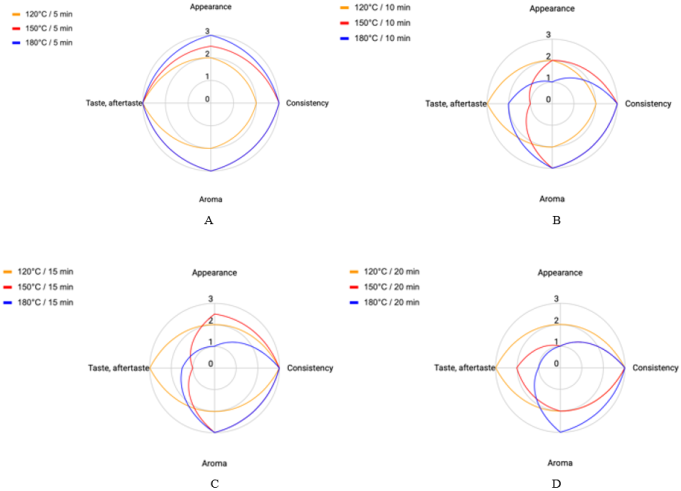
At a fixed toasting time of 5 min, increasing temperature was associated with higher scores for appearance, consistency, and aroma, with the highest values observed at 180.0 ± 0.5°C (
Figure 2A). In contrast, taste and aftertaste scores remained consistently high across all temperatures. These results indicate a clear temperature-related trend in selected sensory attributes; no statistical analysis was conducted owing to the small panel size and descriptive design of the sensory evaluation.
At a toasting time of 10 min (
Figure 2B), increasing temperature negatively affected appearance, with scores declining at 180.0 ± 0.5°C, while consistency and aroma improved at higher temperatures, reaching their highest values at 150.0-180.0 ± 0.5°C. In contrast, taste and aftertaste showed no consistent positive trend, with the lowest score observed at 150.0 ± 0.5°C. These results indicate that, at 10 min of toasting, higher temperatures enhanced structural and aromatic attributes but compromised visual quality and, in some cases, sensory acceptability of flavor.
At a toasting time of 15 minutes (
Figure 2C), increasing temperature reduced appearance scores, with the lowest value observed at 180.0 ± 0.5 °C, while consistency remained high across all temperatures. Aroma improved with higher temperatures, reaching its maximum at 150.0-180.0 ± 0.5 °C, whereas taste and aftertaste declined at elevated temperatures, indicating the onset of off-flavors or over-toasting. These results suggest that prolonged toasting enhances texture and aroma but can negatively affect visual appeal and flavor at higher temperatures.
At 20 minutes of toasting (
Figure 2D), appearance declined at higher temperatures, with the lowest scores observed at 150.0 ± 0.5°C and 180 .0 ± 0.5°C, which were the same. Consistency remained high across all temperatures, while aroma increased slightly with temperature, reaching its highest score at 180.0 ± 0.5°C. Taste and aftertaste decreased with increasing temperature, with the lowest score at 180.0 ± 0.5°C, indicating the development of off-flavors. Overall, prolonged toasting enhanced aroma and maintained texture but compromised visual quality and flavor at higher temperatures.
Figure 2. Sensory Characteristics of Oat Flakes Toasted at Different Temperatures for 5 Minutes (A); for 10 Minutes (B); for 15 Minutes (C); for 20 Minutes (D).
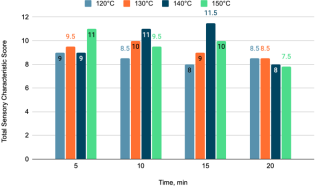
Sensory scores of Brazil nuts were analyzed to assess the effect of toasting temperature at each time point (
Figure 3). Scores for 16 samples, covering four temperatures (120.0, 130.0, 140.0, 150 .0 ± 0.5°C) and four durations (5, 10, 15, 20 min), were recorded. A one-way ANOVA was run at each time point to test whether temperature affected the sensory total score. At 5 min there was no significant temperature effect (p < 0.256), and the same was true at 10 min (p < 0.111). At 15 min, the ANOVA returned an extreme result (p < 0.001) because replicate scores within each temperature were identical (zero within-group variance) while the temperature means differed, so this should be interpreted as a very strong mean separation; standard post-hoc inference is unstable under zero within-group variance. At 20 min, there was a significant temperature effect (p < 0.00934); Tukey HSD indicated that 150°C scored significantly lower than 120°C (p < 0.01) and 140°C (p < 0.05), while the remaining pairwise differences at 20 minutes were not significant (p > 0.05).
Figure 3. Total Sensory Characteristic Scores of Brazil Nut Samples.
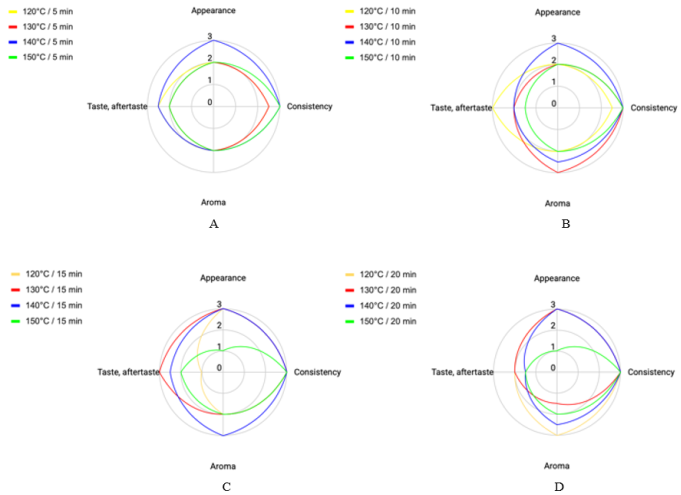
To evaluate each sensory attribute separately,
Figure 4 was created to compare the scores for appearance, consistency, aroma, and taste/aftertaste across all toasting durations. At a toasting time of 5 minutes (
Figure 4A), appearance scores were highest at 140.0 ± 0.5 °C, while consistency improved progressively with temperature, reaching the maximum at 140.0-150.0 ± 0.5 °C. Aroma remained relatively stable across all temperatures, and taste/aftertaste showed minor variation, with slightly higher scores at 120.0 ± 0.5 °C and 140.0 ± 0.5 °C. Overall, short-duration toasting moderately enhanced texture and appearance, while aroma and flavor remained largely consistent.
At a toasting time of 10 minutes (
Figure 4B), appearance was highest at 140.0 ± 0.5 °C, while consistency improved with increasing temperature, reaching maximum scores at 130.0-150.0 ± 0.5 °C. Aroma peaked at 130 °C and declined slightly at higher temperatures, whereas taste and aftertaste decreased at 150.0 ± 0.5 °C, showing the development of mild off-flavors. These results indicate that moderate toasting enhances texture and aroma, but prolonged exposure at higher temperatures can negatively affect flavor perception.
At a toasting time of 15 minutes, Brazil nuts achieved their highest overall sensory scores across most attributes (
Figure 4C). Findings confirmed that toasting at 140.0 ± 0.5°C for 15 min produced the most favorable combination of appearance, aroma, texture, and taste, whereas lower temperatures resulted in underdeveloped flavor and higher temperatures caused visual and flavor degradation. These results reinforce the importance of moderate toasting conditions to optimize sensory quality while minimizing oxidative damage in Brazil nuts.
At a toasting time of 20 minutes, appearance and consistency remained high at 120.0-140.0 ± 0.5 °C, while appearance dropped at 150.0 ± 0.5 °C (
Figure 4D). Aroma was highest at 120.0 ± 0.5 °C but declined at higher temperatures, and taste/aftertaste decreased across all temperatures, with the lowest scores at 140.0-150.0 ± 0.5 °C. These results indicate that prolonged toasting preserves texture at moderate temperatures but negatively affects flavor and aroma at higher temperatures, suggesting that very long heat exposure can compromise overall sensory quality.
Figure 4. Sensory Characteristics of Brazil Nuts Toasted at Different Temperatures for 5 Minutes (A); for 10 Minutes (B); for 15 Minutes (C); for 20 Minutes (D).
3.2. Moisture Content and Peroxide Value
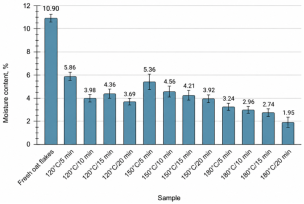
The moisture content of oat flakes decreased progressively with increasing toasting temperature and time (
Figure 5). Fresh, untoasted flakes contained 10.90 ± 0.10% moisture, which dropped to 5.86 ± 0.05% after 5 min at 120 °C and 3.69 ± 0.03% after 20 min at 120 °C. At 150 °C, moisture ranged from 5.36 ± 0.23% (5 min) to 3.92 ± 0.18% (20 min), while at 180 °C, it decreased from 3.24 ± 0.10% (5 min) to a minimum of 1.95 ± 0.08% (20 min). Two-way analysis of variance (ANOVA) revealed that both toasting temperature and time had a statistically significant effect on the moisture content of oat flakes (p < 0.05). Fresh oat flakes served as the control sample and exhibited significantly higher moisture content than all toasted treatments (p < 0.05). Tukey’s honestly significant difference (HSD) post-hoc test confirmed significant differences among individual temperature-time combinations, with progressively lower moisture levels observed at higher toasting temperatures and longer processing times.
Figure 5. Moisture Content of Oat Flakes at Different Toasting Temperatures and Times.
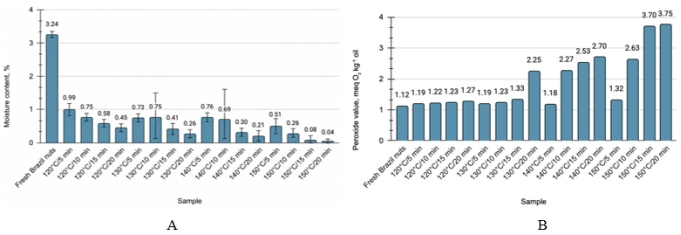
The moisture content of Brazil nuts decreased markedly with increasing toasting temperature and time (
Figure 6A). Fresh nuts contained 3.24 ± 0.05% moisture, which declined to 0.99 ± 0.11% after 5 min at 120 °C and 0.45 ± 0.08% after 20 min at 120 °C. At 130 °C, moisture ranged from 0.73 ± 0.11% (5 min) to 0.26 ± 0.05% (20 min), while at 140 °C it decreased from 0.76 ± 0.02% (5 min) to 0.21 ± 0.05% (20 min). At 150 °C, moisture dropped from 0.51 ± 0.07% (5 min) to a minimum of 0.04 ± 0.03% (20 min). Two-way ANOVA showed that both toasting temperature and duration had a statistically significant effect on moisture content (p < 0.05), and Tukey’s honestly significant difference (HSD) post-hoc test identified significant differences between specific temperatures and time combinations. Moisture reduction during toasting is well documented across nut types, with toasted nuts generally showing lower moisture and water activity that contribute to improved texture and extended shelf life by limiting microbial growth and hydrolytic degradation
| [23] | Kulik, K. & Waszkiewicz-Robak, B. (2025). The effect of roasting on the health-promoting components of nuts: fatty acids, polyphenols, and antioxidant activity. Molecules, 30(23), 4594. https://doi.org/10.3390/molecules30234594 |
[23]
.
The peroxide value of Brazil nut oil increased with temperature and duration (
Figure 6B), rising from 1.12 meq O
2 kg⁻
1 in fresh nuts to 3.75 meq O
2 kg⁻
1 at 150.0 ± 0.5 °C for 20 min. Both toasting temperature and time have significant effects on PV, with PV differing by temperature (p < 0.0076) and changing across toasting times from 5 to 20 minutes (p < 0.037).
Figure 6. Moisture Content of Brazil Nuts at Different Toasting Temperatures and Times (A) and Peroxide Value of Brazil Nuts at Different Toasting Temperatures and Times (B).
3.3. Total Phenolic Compounds
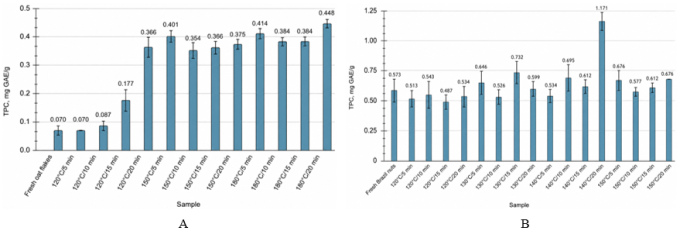
The TPC of the oat samples ranged from 0.070 to 0.448 mg GAE/g (
Figure 7A). Fresh oat flakes showed the lowest TPC (0.070 ± 0.034), while the highest value was observed after toasting at 180°C for 20 min (0.448 ± 0.095). Overall, thermal treatment increased TPC, with higher temperatures and longer toasting times generally resulting in greater phenolic content.
The TPC of Brazil nut samples ranged from 0.487 to 1.171 mg GAE/g (
Figure 7B). Fresh Brazil nuts showed a TPC value of 0.573 ± 0.140, while the highest content was observed after toasting at 140°C for 20 min (1.171 ± 0.095). Thermal treatment generally increased TPC compared with fresh samples, although the effect depended on toasting temperature and time.
Figure 7. Total phenolic compounds in oat (A) and Brazil nut (B) samples.
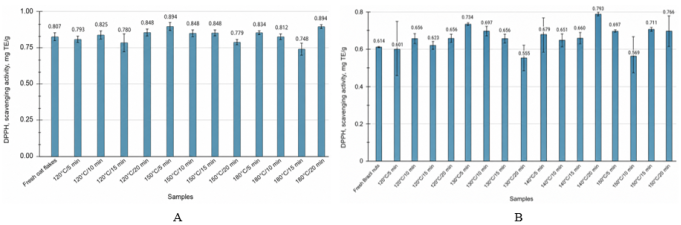
The DPPH radical scavenging activity of fresh and toasted oat flakes is presented in
Figure 8a. Fresh oat flakes showed an antioxidant activity of 0.807 ± 0.032 mg TE/g. Toasting at 120°C caused only minor changes, with values ranging from 0.780 to 0.848 mg TE/g. The highest antioxidant activity was observed after toasting at 150°C for 5 min (0.894 ± 0.028 mg TE/g), representing an approximately 11% increase compared to the control. At 150°C, prolonged toasting (20 min) reduced the activity to 0.779 ± 0.016 mg TE/g. At 180°C, DPPH activity decreased after 15 min (0.748 ± 0.100 mg TE/g) but increased again after 20 min to 0.894 ± 0.028 mg TE/g, matching the highest value obtained.
Overall, moderate toasting improved the antioxidant capacity of oats, whereas prolonged heating temporarily reduced DPPH activity, likely due to degradation of heat-sensitive antioxidants. The increase under optimal toasting conditions is attributed to the release of bound phenolic compounds and the formation of antioxidant Maillard reaction products.
The DPPH radical scavenging activity of fresh and toasted Brazil nuts is presented in
Figure 8b. Fresh Brazil nuts showed an antioxidant activity of 0.614 ± 0.008 mg TE/g. Toasting at 120°C had little effect on DPPH activity, with values ranging from 0.601 to 0.656 mg TE/g. Higher temperatures generally increased antioxidant activity, reaching 0.734 ± 0.008 mg TE/g at 130°C/5 min, 0.793 ± 0.021 mg TE/g at 140°C/15 min, and 0.766 ± 0.080 mg TE/g at 150°C/20 min. The lowest value (0.555 ± 0.057 mg TE/g) was observed after 130°C/20 min.
Figure 8. DPPH scavenging activity of oat (A) and Brazil nut (B) samples.
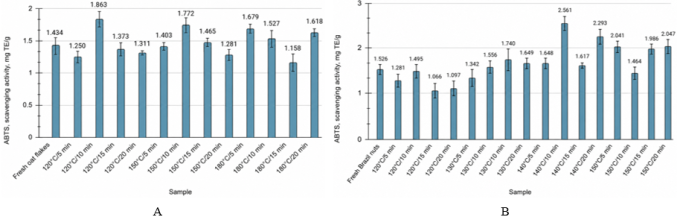
The ABTS radical scavenging activity of fresh and toasted oat flakes is presented in
Figure 9a. Fresh oat flakes exhibited an antioxidant activity of 1.434 ± 0.242 mg TE/g. Toasting at 120°C produced variable effects, with ABTS values ranging from 1.250 ± 0.183 to 1.863 ± 0.249 mg TE/g, the highest value being observed after 10 min of toasting. At 150°C, antioxidant activity remained relatively stable (1.281-1.772 mg TE/g), with the maximum value recorded after 10 min (1.772 ± 0.221 mg TE/g). Toasting at 180°C also influenced ABTS activity, reaching 1.679 ± 0.140 mg TE/g after 5 min and 1.618 ± 0.091 mg TE/g after 20 min, while the lowest value (1.158 ± 0.289 mg TE/g) was observed after 15 min.
The ABTS radical scavenging activity of fresh and toasted Brazil nuts is presented in
Figure 9b. Fresh Brazil nuts exhibited an antioxidant activity of 1.526 ± 0.109 mg TE/g. Toasting at 120°C resulted in variable antioxidant activity, with ABTS values ranging from 1.066 ± 0.121 to 1.495 ± 0.158 mg TE/g, indicating little improvement compared with the fresh sample. At 130°C, antioxidant activity gradually increased, reaching 1.740 ± 0.234 mg TE/g after 15 min. A marked increase was observed at 140°C, where the highest ABTS value of the study (2.561 ± 0.204 mg TE/g) was obtained after 15 min of toasting. At 150°C, ABTS activity remained high, ranging from 1.464 ± 0.154 to 2.293 ± 0.194 mg TE/g, with the highest value recorded after 5 min.
Figure 9. ABTS scavenging activity of oat (A) and Brazil nut (B) samples.
4. Discussion
The present study demonstrates that toasting conditions significantly influence the sensory, physicochemical, and antioxidant properties of oats and Brazil nuts, highlighting the importance of optimizing ingredient-specific thermal treatments for the development of functional muesli formulations. Both toasting temperature and duration interacted to determine product quality, indicating that a single processing condition may not be equally suitable for different ingredients.
For oat flakes, moderate toasting improved sensory acceptability by enhancing desirable toasted aroma, flavor, and crispness, whereas prolonged heating at higher temperatures reduced sensory scores. These findings agree with previous studies showing that controlled heat treatment of oats promotes the formation of aroma-active compounds, including pyrazines and furans, which contribute to characteristic nutty and toasted notes
| [5] | Li, X., McGorrin, R. J., & Heydanek, T. (2022). Effect of industrial processing on the volatiles, enzymes and lipids of wholegrain and rolled oats. Food Research International 157. https://doi.org/10.1016/j.foodres.2022.111243 |
| [6] | Törős, G., Peles, F., Elramady, H. & Prokisch, J. (2023). To what extent can maillard reaction products influence the probiotic and harmful bacteria?. Egyptian Journal of Soil Science.
https://doi.org/10.21608/ejss.2023.189687.1569 |
[5, 6]
. However, excessive thermal exposure resulted in reduced sensory quality, probably due to excessive browning and the loss of desirable volatile compounds, consistent with reports that over-processing negatively affects the sensory characteristics of cereal products
| [7] | Apaydın, H., Demirci, M., Bölük, E., Kopuk, B., & Palabiyik, I. (2024). Effect of different roasting conditions on the physicochemical properties, acrylamide concentration, and mineral bioaccessibility of nuts. Food Bioscience 58.
https://doi.org/10.1016/j.fbio.2024.103646 |
[7]
.
A similar trend was observed for Brazil nuts. Moderate toasting temperatures enhanced overall sensory quality, likely through controlled Maillard reactions and limited lipid oxidation, which contribute positively to flavor, aroma, and texture
| [7] | Apaydın, H., Demirci, M., Bölük, E., Kopuk, B., & Palabiyik, I. (2024). Effect of different roasting conditions on the physicochemical properties, acrylamide concentration, and mineral bioaccessibility of nuts. Food Bioscience 58.
https://doi.org/10.1016/j.fbio.2024.103646 |
| [24] | Yunusa, A., Nouruddeen, Z., Abubakar, S. & Abduirahman, M. (2023). Effects of roasting conditions on sensory attributes, polyphenolic content and DPPH radical scavenging activity of peanut (Arachis hypogaea). Croatian Journal of Food Science and Technology 15(2): 130-140.
https://doi.org/10.17508/CJFST.2023.15.2.01 |
[7, 24]
. In contrast, higher temperatures (150.0 ± 0.5°C) combined with prolonged toasting significantly reduced sensory acceptability because of excessive browning and the development of bitter and burnt flavors. This deterioration is consistent with previous findings showing that nuts rich in unsaturated fatty acids are particularly susceptible to heat-induced lipid oxidation, which adversely affects aroma, flavor, and overall consumer acceptance
| [13] | Tahmasbian, I., Wallace, H., Gama, T. & Bai, SH. (2021). An automated non-destructive prediction of peroxide value and free fatty acid level in mixed nut samples. LWT 143.
https://doi.org/10.1016/j.lwt.2021.110893 |
| [25] | Huang, Y., Liu, C., Huang, F., Zhou, Q., Zheng, C., Liu, R.,% Huang, J. (2022). Quality evaluation of oil by cold‐pressed peanut from different growing regions in China. Food Sci Nutr. 14;10(6): 1975-1987. https://doi.org/10.1002/fsn3.2813 |
[13, 25]
. Together, these findings emphasize that optimizing toasting conditions for each ingredient is essential to maximize sensory quality in functional muesli products.
Moisture reduction during toasting also played an important role in determining product quality. Lower moisture content contributes to improved crispness and texture while simultaneously enhancing shelf-life by reducing water activity and limiting microbial growth
| [26] | Allai, F. M., Junaid, P. M., Azad, Z. R. A., Gul, K., & Siddiqui, S. A. (2023). Impact of moisture content on microstructural, thermal, and techno-functional characteristics of extruded whole-grain-based breakfast cereal enriched with Indian horse chestnut flour. Food Chemistry: X, 20, 100959.
https://doi.org/10.1016/j.fochx.2023.100959 |
[26]
. Controlled drying and thermal treatment have previously been shown to significantly influence the moisture content, texture, and storage stability of breakfast cereals and cereal flakes
| [26] | Allai, F. M., Junaid, P. M., Azad, Z. R. A., Gul, K., & Siddiqui, S. A. (2023). Impact of moisture content on microstructural, thermal, and techno-functional characteristics of extruded whole-grain-based breakfast cereal enriched with Indian horse chestnut flour. Food Chemistry: X, 20, 100959.
https://doi.org/10.1016/j.fochx.2023.100959 |
[26]
. The present results confirm that toasting effectively reduced the moisture content of oat flakes, thereby improving both textural and preservation properties. Although the lowest moisture contents were achieved at 180.0 ± 0.5°C for 15-20 min, moderate toasting at 180.0 ± 0.5°C for 5 min provided an optimal balance between crispness, color, and overall sensory quality, making it a suitable processing condition for functional muesli formulations.
The effect of toasting on lipid stability was evident from the peroxide value (PV) results. Increasing PVs reflected enhanced primary lipid oxidation, which is expected during heat processing as oxygen reacts with unsaturated fatty acids to produce lipid hydroperoxides
. Similar increases in peroxide formation have been reported for other toasted tree nuts exposed to elevated roasting temperatures
. Since higher PVs are associated with oxidative deterioration, off-flavor development, and reduced nutritional quality, these findings suggest that moderate toasting conditions are preferable to preserve oil stability while still achieving desirable sensory and textural characteristics.
Thermal processing also influenced the phenolic composition of both oats and Brazil nuts. The increase in total phenolic content (TPC) observed in toasted oats is consistent with previous reports demonstrating that roasting enhances the extractability of phenolic compounds and antioxidant activity compared with untreated grains
| [28] | Li, H., Mao, Y., Ma, D., Li, H., Liu, R., & Siriamornpun, S. (2024). Impact of cooking methods on phenolic acid composition, antioxidant activity, and starch digestibility of Chinese triticale porridges: A comparative study between atmospheric pressure and high pressure boiling. Foods, 13(2), 230.
https://doi.org/10.3390/foods13020230 |
[28]
. Earlier work by Dimberg et al.
likewise reported improved availability of phenolic acids and avenanthramides following thermal treatment, although the magnitude of this increase depended on processing conditions. Similar responses have been reported for roasted nuts. Adelina et al.
| [30] | Adelina, N. M., Wang, H., Zhang, L., Yang, K., Zhang, L., & Zhao, Y. (2022). Evaluation of roasting conditions as an attempt to improve bioactive compounds and antioxidant activities of pine nut shell and skin. Waste and Biomass Valorization, 13(2), 845-861. https://doi.org/10.1007/s12649-021-01589-6 |
[30]
observed increased antioxidant capacity and phenolic content following roasting, attributing these changes to improved extractability of bioactive compounds. In addition, Kornsteiner et al.
reported considerable variation in phenolic concentrations among different nut species, including Brazil nuts, reflecting differences in genotype, growing conditions, and analytical methodology. Therefore, variations between studies are likely attributable to differences in raw material origin, roasting conditions, extraction procedures, and analytical methods used for TPC determination.
The antioxidant activity measured using the DPPH assay further supports the beneficial effects of moderate thermal processing. The DPPH values obtained in the present study (0.555-0.793 mg TE/g) fall within the range previously reported for Brazil nuts. Vásquez-Rojas et al.
| [32] | Vásquez-Rojas, W. V., Martín, D., Miralles, B., Recio, I., Fornari, T., & Cano, M. P. (2021). Composition of Brazil nut (Bertholletia excelsa HBK), its beverage and by-products: A healthy food and potential source of ingredients. Foods, 10(12), 3007. https://doi.org/10.3390/foods10123007 |
[32]
summarized earlier studies reporting DPPH activity of approximately 2.6 µmol TE/g fresh weight for raw Brazil nuts, while their own investigation measured 1.72 ± 0.11 µmol TE/g. Reported differences have been attributed to genotype, geographical origin, and analytical methodology. In the present study, moderate toasting enhanced radical scavenging activity, suggesting that heat treatment promoted the formation of antioxidant Maillard reaction products while improving the availability of naturally occurring antioxidants. Conversely, prolonged heating likely resulted in degradation of heat-sensitive antioxidant compounds, reducing overall antioxidant capacity
| [32] | Vásquez-Rojas, W. V., Martín, D., Miralles, B., Recio, I., Fornari, T., & Cano, M. P. (2021). Composition of Brazil nut (Bertholletia excelsa HBK), its beverage and by-products: A healthy food and potential source of ingredients. Foods, 10(12), 3007. https://doi.org/10.3390/foods10123007 |
| [33] | Verghese, M., Willis, S., Boateng, J., Gomaa, A., & Kaur, R. (2021). Effect of food processing on antioxidant potential, availability, and bioavailability. Annual Review of Food Science and Technology, 12, 307-329.
https://doi.org/10.1146/annurev-food-062420-105140 |
[32, 33]
.
Similar patterns were observed for ABTS radical scavenging activity. The ABTS values recorded in the present study (1.158-1.863 mg TE/g) are comparable with those reported for oats and oat-based products in the literature. Alemayehu et al.
| [2] | Alemayehu, G. F., Forsido, S. F., & Amare, E. (2023). Nutritional and phytochemical composition and associated health benefits of oat (Avena sativa) grains and oat‐based fermented food products. The Scientific World Journal.
https://doi.org/10.1155/2023/2730175 |
[2]
summarized ABTS antioxidant activities ranging from approximately 0.8 to 3.5 mg TE/g, with differences primarily associated with genotype, processing conditions, and extraction methods. Bryngelsson et al.
| [34] | Bryngelsson, S., Dimberg, L. H., & Kamal-Eldin, A. (2002). Effects of commercial processing on levels of antioxidants in oats (Avena sativa L.). Journal of Agricultural and Food Chemistry, 50, 1890-1896.
https://pubs.acs.org/doi/10.1021/jf011222z |
[34]
also reported increased antioxidant capacity following thermal processing of oats, attributing the improvement to enhanced extractability of phenolic compounds and the formation of Maillard reaction products. Likewise, moderate toasting of Brazil nuts in the present study increased ABTS radical scavenging activity, with the greatest enhancement observed at 140-150°C. This improvement is likely associated with the release of bound antioxidant compounds together with the generation of antioxidant Maillard reaction products during heating, consistent with observations reported for roasted nuts and other plant-based foods
.
Overall, the findings demonstrate that moderate toasting conditions provide the best balance between sensory quality, moisture reduction, lipid stability, and antioxidant retention for both oats and Brazil nuts. Although higher temperatures and extended toasting further reduced moisture content, these conditions accelerated lipid oxidation and diminished sensory quality through excessive browning and the development of undesirable flavors. Therefore, carefully optimized, ingredient-specific toasting conditions are essential for maximizing the nutritional, technological, and sensory quality of functional muesli formulations.







 Share This Article
 Twitter
 Linked In
 Facebook
 Copy
Copy Download